
2025/Web App
Nexus
Link aggregation SaaS platform built in a Monorepo with scalable Full-Stack architecture.
- Next
- React
- TypeScript
- TailwindCSS
- Node
- Express
- Prisma
- PostgreSQL
- Docker
- Jest
- Testing Library

I'm Ademir, a Software Engineer with a Computer Science degree, focused on building scalable web applications and turning complex requirements into maintainable, performant products. My core stack is React, Next.js, TypeScript, and Node.js, with strong attention to frontend architecture, backend integration, testing, and developer experience.
In projects like Nexus, I designed a full-stack monorepo architecture that unified frontend and backend through shared contracts and end-to-end type safety, while also implementing secure APIs, automated tests, and CI/CD pipelines. In Simple Motion React, I explored React lifecycle behavior to build optimized animation components. In Fix My Halo, I used Rust and WebAssembly to solve browser-side graphics-processing bottlenecks with a shared high-performance core.
I enjoy engineering problems that involve performance, usability, and long-term maintainability, especially when the solution has to work well both for users and for developers.
Education
Computer Science
Languages
Portuguese (Native) / English
Location
Laguna/SC, Brazil
Link aggregation SaaS platform built in a Monorepo with scalable Full-Stack architecture.

Tool to fix graphical artifacts in game development, available as a WebApp and CLI.
Declarative animation library for React inspired by Vue, with zero extra dependencies and focused on bundle size.
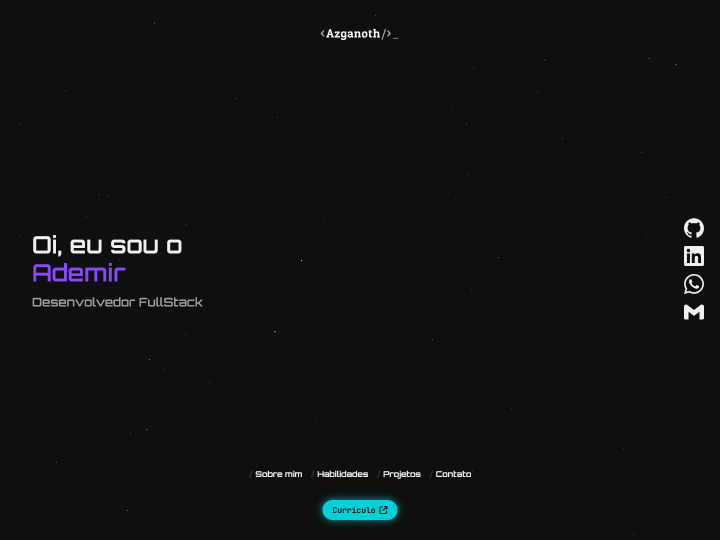
Personal portfolio developed with SvelteKit and TailwindCSS, focused on content, immersion, and performance.
Complete Lua language grammar for the Tree-sitter parser, with external scanner for strings and comments.

Virtual art gallery with custom Masonry layout and Static Site Generation (SSG).